
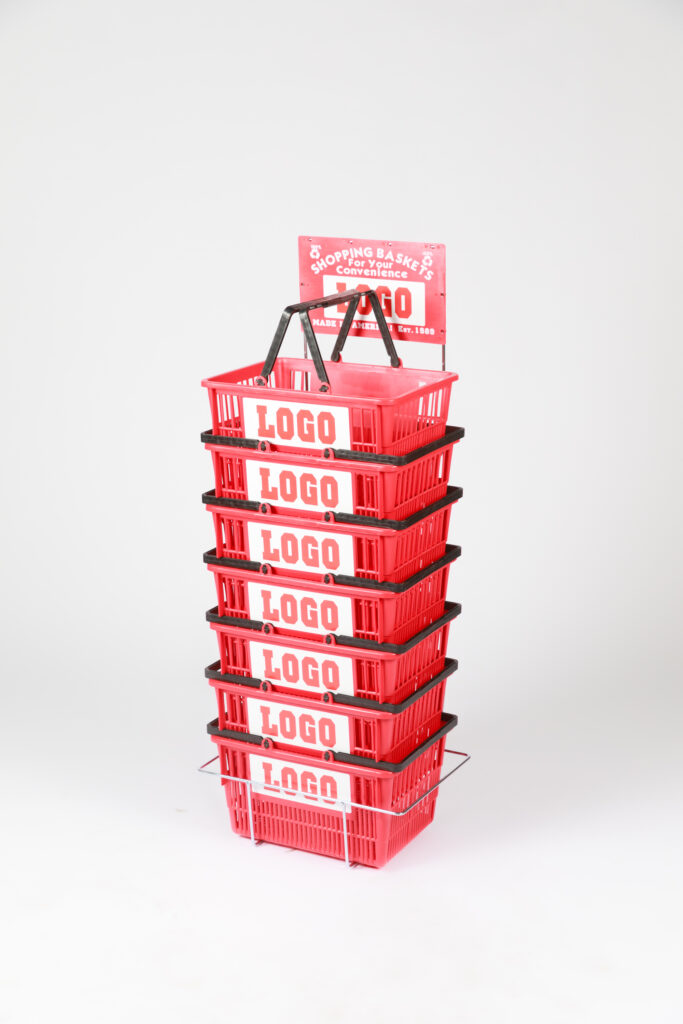
It’s easy to reduce the choice between plastic and wire handheld baskets to a matter of appearance and utility, but there are many other factors that influence the ideal fit. To ensure you’re stocking up on handheld baskets best suited to your retail outlet, consider factors such as your store type, customer usage volume, and climate.
At Good L Corp., we’ve spent over three decades manufacturing durable, top-quality handheld shopping baskets at our family-owned plant in La Vergne, TN. In that time, we’ve supplied retailers across virtually every vertical: department stores, pharmacies, boutiques, home improvement stores, liquor stores, and beyond. We’ve seen firsthand what works and what doesn’t across many different store environments, customer bases, and climates. No offshore supplier can match that combination of American-made quality and hard-won, grassroots knowledge. So, whether you’re a grocery store in Seattle or a specialty retailer in Miami, we know which basket is right for your environment, and we’ve put together this guide to help you make that call with confidence.
Matching Your Basket to Your Store Type
The nature of your retail environment is one of the strongest predictors of which basket material will best serve both you and your customers.
Convenience stores, pharmacies, and boutiques tend to see customers making quick, grab-and-go shopping trips. For these environments, plastic shopping baskets are the clear winner. They’re lightweight, easy to maneuver, and quiet; a combination that keeps the shopping experience fast and pleasant. Plastic baskets are also far less likely to snag delicate clothing or scratch premium packaging, making them the go-to choice for apparel and cosmetics retailers.
Hardware stores and garden centers are a different story. When customers are loading up on tools, fasteners, or garden supplies, they need a basket that can take the weight. Handheld wire retail shopping baskets built from welded steel are engineered for exactly this kind of use. Their rigid frame handles heavy, angular merchandise that might puncture or scratch a standard plastic basket. If your floor sees heavy-duty shopping on a regular basis, wire is the material for you.
How Customer Usage Patterns Should Drive Your Decision
Beyond store type, thinking about how your baskets are used, day in and day out, is also important.
Comfort and ergonomics are integral to a seamless shopping experience. Customers carrying a heavy basket can potentially set it down sooner and spend less time browsing as a result. Plastic baskets are significantly lighter than their wire counterparts and typically feature molded or ergonomic handles that reduce wrist and arm strain, which can encourage longer dwell times and lead to more items in the basket.
Hygiene is another practical consideration. Plastic baskets are easy to wipe down, sanitize, and even power-wash, offering a meaningful advantage for grocers, pharmacies, and any retailer with high customer traffic.
Noise levels are also something to think about. Wire baskets can rattle and clang when customers use them or stack them. In a quiet boutique or pharmacy, that noise can disrupt the shopping atmosphere. Plastic keeps noise levels to a minimum.
Load capacity is where wire beats plastic. Quality steel wireframes distribute weight evenly across the basket structure and won’t bend or warp under heavy loads. Lower-grade plastics, on the other hand, can crack under significant stress. (This is why the quality of your basket’s raw materials is important.)
What Retail Store Owners Need to Know: Climate Is a Factor Most Miss
Where your store is located matters as much as what you’re selling.
For retailers in high-humidity or coastal regions, moisture is always a concern. Standard metal baskets are vulnerable to rust and oxidation, especially in damp or salt-air environments. High-density polyethylene (HDPE) and polypropylene (PP) plastics, by contrast, are impervious to rust and corrosion. They’ll maintain their structural integrity and appearance through years of exposure to humid, rainy, or coastal conditions.
At Good L, our wire shopping baskets are reinforced with a rust-resistant coating, removing the corrosion question from the equation. For dry inland climates, our wire baskets are also great for the long haul. In these environments, a well-finished steel basket can offer the structural strength needed for high-volume or heavy-use retail settings.
Retailers operating in wet or outdoor environments, such as garden centers and beachside shops, should default to plastic for the very same reason.
And as retail evolves and sustainability becomes an increasingly important consideration for consumers and businesses alike, transparency in material sourcing is something many shoppers look for. Customers now expect a commitment to both quality and eco-friendliness.
One Size Does Not Fit All
The answer to the right handheld basket for your store isn’t universal. Instead, it comes from considering your environment, your customer’s needs and expectations, and how your baskets will be used day after day. Plastic is great for comfort, hygiene, noise control, and moisture-heavy climates. Wire excels in structural strength and heavy-duty retail use.
At Good L Corp., our handheld wire shopping baskets are constructed from rust-resistant steel with a protective bright zinc and baked enamel finish, built to last in demanding environments. Our plastic baskets are made from 100% recycled polypropylene with fiberglass-filled nylon handles, making them lightweight, durable, and available in a full spectrum of colors with custom logo imprinting. Both lines are made right here in the USA and designed to do more than carry products: they promote your brand.
Not sure which type is right for your store? Our team is ready to help you find the perfect match and provide a free quote.
Shop local. Shop American. Get in touch with us at Good L Corp. for a hand-help shopping basket strategy that will stand the test of time, climate, store type, and use.
Request a Quote
Get a boost to your impulse sales which ultimately leads to an overall improvement of your total sales. Don’t you want to increase sales? Of course you do!