
When you’re striving to be the highest-performing grocery store in your segment and area, you need to maximize space. Every square foot needs to be intentional, with everything earning its place. And one of the best space-saving tools available to you today is the shopping basket. Specifically, collapsible and stackable basket designs are reshaping how grocery retailers think about floor space, customer flow, and operational efficiency.
Here’s what the data and the design science tell us.
The Square Footage Problem Grocery Stores Can’t Ignore
Grocery retail operates on notoriously thin margins. That means every square foot of selling space has to pull its weight. According to the Food Marketing Institute, the average U.S. supermarket carries around 32,000 items in roughly 42,000 square feet. In smaller-format grocers and neighborhood markets, inventory pressures naturally intensify.
Traditional rigid baskets, when not in use, consume valuable real estate near store entrances and throughout high-traffic zones. Multiply that by dozens of baskets, and you’re looking at meaningful square footage that could be occupied by end caps, impulse displays, or simply better traffic flow.
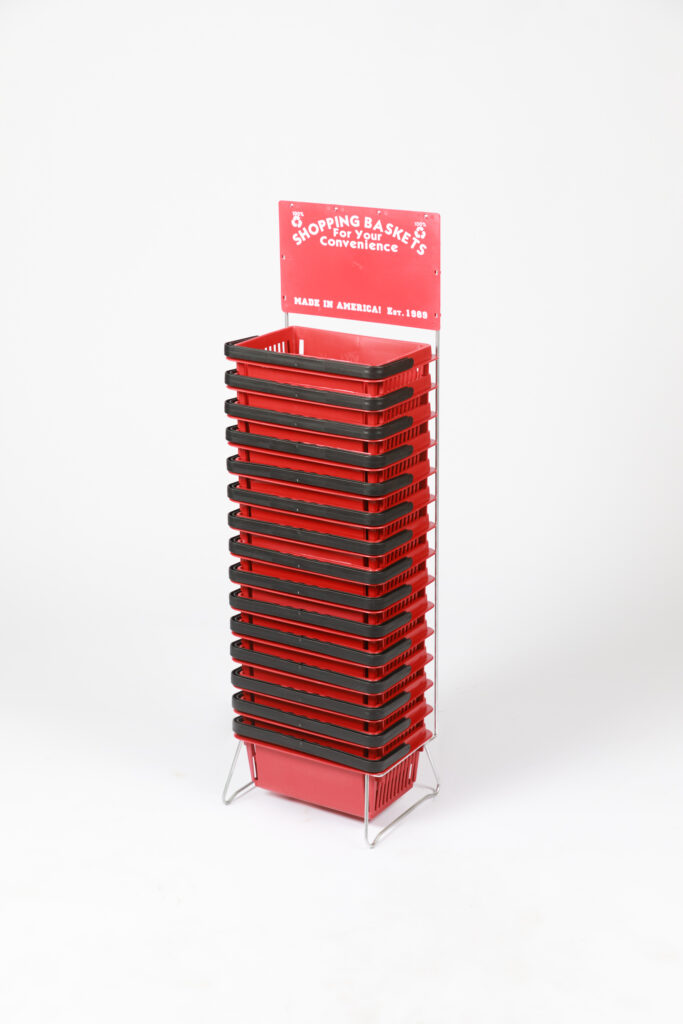
Collapsible and stackable basket designs solve this problem structurally. When a collapsible shopping basket with handles is not in active use, it nests compactly, reducing its footprint significantly compared to an open configuration. For grocers managing tight entrances or seasonal floor resets, this kind of flexibility can become a competitive advantage.
How Stackable Designs Support Modern Store Layouts
Beyond the functionality of collapsible shopping baskets, stackable basket designs introduce another layer of operational ease. Stackability allows you to consolidate basket stations, keeping baskets accessible at entrances, end aisles, and near the deli or bakery without creating visual clutter.
Grocery retailers are increasingly adopting a distributed basket strategy, placing smaller clusters of baskets throughout the store rather than relying on a single entrance station. Research in retail environmental psychology suggests that when shoppers pick up a basket mid-trip, they are significantly more likely to add unplanned items to their purchase. Accessible baskets throughout the store, enabled by the compact profile of stackable designs, can directly influence impulse buying.
Stackability also matters in the back of the house. High-capacity stacking means more baskets can be stored in receiving areas, cleaning stations, or back-rooms without compromising space for staff or supplies.
Material Innovation: Why Modern Baskets Are a Must
Not all stackable or collapsible baskets are created equal, and grocery retailers should pay close attention to material composition. Baskets made from 100% recycled plastics have advanced significantly in structural integrity. Modern recycled polymer blends have load-bearing capacities that rival those of traditional plastic, giving you and your customers extra peace of mind as they fill their baskets to the brim.
At Good L Corp., we manufacture plastic hand-held shopping baskets from 100% recycled materials, and our large basket models can handle up to 200 pounds! Thanks to intentional engineering, our baskets won’t crack under the weight of a full grocery load.
In addition, if sustainability is a core value, partnering with a manufacturer that uses recycled content supports ESG goals and provides a talking point for customer-facing communications. If your customers are asking what you’re doing to support a healthier planet, and you partner with our team at Good L, you can tell them that your entire basket inventory is made of 100% recycled plastic.
Baskets That Offer Cost-Efficient Branding Opportunities
Like most grocery store retailers, you’re probably investing in signage, loyalty programs, and advertising. But one underutilized branding opportunity that travels throughout your store throughout every shopping trip is the basket itself.
Our collapsible and stackable baskets can be customized with your store’s logo and color palette, turning every basket into a mobile brand impression and reinforcing your identity at zero incremental cost beyond the initial customization.
For regional grocery chains looking to build community recognition, or independent grocers competing against national players, this kind of low-cost, high-visibility branding offers a smart advantage.
Choosing the Right Basket Mix for Your Store’s Footprint
Just like no two grocery stores are identical, the right basket strategy depends on your store’s size, layout, and customer demographics. A compact urban market serving quick-trip shoppers may benefit most from a fleet of smaller, highly portable baskets that collapse and station easily near the door. A larger suburban supermarket might prioritize tall-format baskets with ergonomic handles to reduce physical fatigue on longer shopping trips.
At Good L Corp., we offer six basket sizes, from mini to tall to roller. And they’re all manufactured right here in the United States. With so much versatility, you can tailor your basket inventory to your specific merchandising strategy and then build that out if needed in the future.
As you evaluate your store plan this quarter, it’s worth asking: are your current baskets doing what they need to do?
Buy Local, Buy American When You Partner With Good L Corp.
As a family-owned Tennessee-based company, we have over 35 years of experience designing, manufacturing, and distributing industry-leading shopping baskets and carts to merchants all across America.
At Good L Corp., we help retailers rethink something as simple as a shopping basket into a high-impact operational tool. From collapsible and stackable designs to fully customized branding, our solutions are built to perform in real-world retail environments.
Request a free quote today and find out how the right basket strategy can improve space efficiency, customer experience, and store performance.
Request a Quote
Get a boost to your impulse sales which ultimately leads to an overall improvement of your total sales. Don’t you want to increase sales? Of course you do!